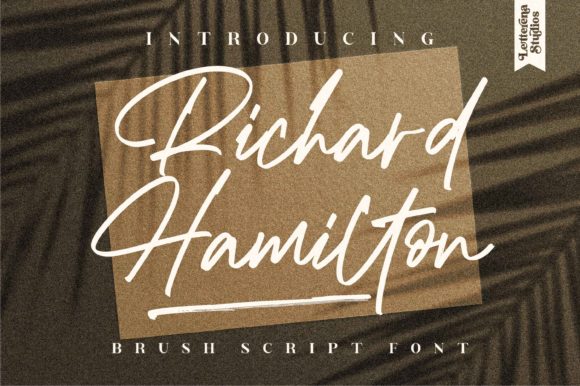
Richard Hamilton: A Handwritten Font for Professional Signature Taste
The selection of a typeface is a foundational decision in any creative project. It establishes tone, communicates brand values, and influences the viewer’s emotional response long before they read the actual words. For professionals seeking an authentic, luxury touch without commissioning a custom handwritten script, the modern handwritten font Richard Hamilton offers a sophisticated and readily available solution. This font fits into the workflow as a key design asset, a tool that can elevate standard materials by imbuing them with a sense of personal craftsmanship and refined elegance.
Understanding Richard Hamilton's Place in the Design Process
Richard Hamilton is a digital font that mimics the fluid, variable strokes of a skilled brush pen or marker. Its characters possess a natural, slightly casual flow while maintaining overall consistency, making it an ideal bridge between the raw authenticity of actual handwriting and the practical demands of digital design. In a broader creative or branding process, its introduction typically occurs during the asset selection phase, after core concepts are defined but before final mockups are produced. It interacts directly with other tools—graphic software like Adobe Illustrator or Canva, stock imagery, color palettes, and layout grids—to become a unifying visual element.
For the entrepreneur or marketer, this means it can be considered alongside logo sketches, brand mood boards, and packaging prototypes. Its use is a strategic decision aimed at achieving a specific outcome: conveying exclusivity, personal attention, or artistic flair. Unlike more rigid or geometric fonts, Richard Hamilton introduces a human element into digital workflows, a factor crucial for projects that aim to feel bespoke or intimately crafted.
Practical Integration into Diverse Professional Workflows
The utility of Richard Hamilton spans from initial concept to final product across numerous fields. Its integration is smooth because it functions as a standard font file, installed and utilized like any other typeface, yet its impact is distinctly stylistic. Here is how it can be applied in real-world contexts, focusing on the preparation and execution stages.
Branding and Identity Projects
For a small business owner developing a brand, consistency across touchpoints is paramount. Richard Hamilton can serve as a secondary or accent font within a brand’s typographic hierarchy. During the preparation phase, after selecting a primary, more neutral font for body text, you might evaluate Richard Hamilton for specific applications. It could be reserved for the brand’s signature logotype, for slogan text on packaging, or for special announcements on social media. This controlled application ensures the handmade taste enhances the brand without compromising readability for large blocks of information. In execution, using it for a logo within a vector program allows for easy scaling and color adjustment, ensuring it remains compatible with print and digital outputs.
Product and Packaging Design
Homeware designs, product packaging, and labels benefit immensely from a font that suggests care and quality. In this workflow, Richard Hamilton often comes into play during the final design stage. Once the structural layout and primary informational typography (like ingredients or instructions) are set using a clean sans-serif, you can introduce Richard Hamilton for the product name or a key benefit statement on the label. On a mug, a single quote rendered in this font transforms it from a generic item into a personalized gift. The key is organization: maintain a design file where the font is used sparingly and purposefully, ensuring it acts as a highlight rather than the entire text base. This approach aids in quality control, as overuse can lead to a cluttered or difficult-to-read design.
Marketing and Promotional Materials
For marketers and freelancers creating posters, t-shirts, or shopping bags, the goal is immediate visual impact. Richard Hamilton excels here for headlines and focal quotes. Its workflow integration involves pairing. During the design process, consider pairing Richard Hamilton with a simple, contrasting font for supporting details. For a event poster, the event name in Richard Hamilton grabs attention, while date, time, and location details in a clear sans-serif provide necessary clarity. This complementary use balances artistic appeal with functional communication. For digital assets like photography watermarks or blog graphics, using the font at a consistent opacity and position helps build a recognizable, premium signature style across all publications.
Personal and Professional Stationery
Invitation cards, greeting cards, and name cards are intimate items where a handwritten feel is highly desirable. For the professional designing these, Richard Hamilton can effectively replace the need for physically handwriting each name or message, ensuring consistency and efficiency while maintaining the desired aesthetic. In preparation, setting up template files in your design software with layers for the background, standard text, and a layer dedicated to the customizable text (like the guest's name) using Richard Hamilton streamlines production. This method is particularly useful for educators or bloggers creating downloadable resources or for small business owners producing uniform but elegant invitation cards for client events.
Implementation Tips for Optimal Use and Long-Term Value
To leverage Richard Hamilton effectively and ensure its long-term value in your toolkit, consider these practical observations on usability and organization.
Consider Context and Contrast: Always evaluate the background and surrounding elements. The organic shapes of Richard Hamilton need space and a contrasting backdrop to shine. Avoid placing it on overly busy imagery or textures that might obscure its delicate strokes.
Respect Its Role as an Accent: For most professional applications, treat Richard Hamilton as a display font. Its strength is in creating focal points—a logo, a headline, a key label. Using it for long paragraphs or body text can compromise readability and dilute its special impact.
Maintain a Brand Asset Library: If you adopt Richard Hamilton for a brand or recurring project, document its use formally. Create a simple brand guide note specifying where it should be used (e.g., "for all product taglines") and, crucially, where it should not be used (e.g., "not for body text in manuals"). This promotes consistency across different team members or future projects.
Pair with Purpose: Its handwritten nature pairs best with fonts that offer stability. Classic serif fonts like Garamond or modern, minimal sans-serif fonts like Helvetica Neue create a harmonious balance. Experiment with pairings in a draft document before finalizing any design.
Check Technical Compatibility: Before finalizing any print project, ensure your printer or service can handle the font file without issues. Exporting designs with text outlined as vectors can sometimes prevent font substitution issues, a useful step for physical products like book covers or packaging.
A Versatile Asset for Luxury and Personal Projects
Ultimately, the Richard Hamilton font is more than just a stylistic choice; it is a versatile asset that integrates into a professional workflow to achieve a specific outcome: the impression of handwritten, signature quality. It serves the creator before a project by providing a ready-made elegant option, during a project as a key design element that interacts with other visual choices, and after a project by contributing to a cohesive, high-quality final product. Its usability across platforms—from digital design software to print production—makes it a reliable and efficient tool.
For the productivity-minded user, its value lies in its ability to elevate standard materials quickly, without the time and cost of manual illustration. For the hobbyist or blogger, it offers an easy path to a more polished, personal aesthetic. By understanding its role as an accent font, preparing designs with thoughtful pairing and contrast, and organizing its use within a broader system, professionals across fields can seamlessly incorporate the sophisticated taste of Richard Hamilton into their work, enhancing everything from a business card to a product label with a touch of deliberate, refined artistry.